I have been nervous about base metal prices, particularly copper, for some time now. Low interest rates worldwide have allowed many hedge funds to engage in the carry trade by borrowing capital in places like Japan and investing it in everything from real estate to emerging market stocks. Earlier this year commodities became the target for their speculative buying.
How else can one explain that from December ‘05 to May ‘06 aluminum was up 50%, copper was up 100%, nickel was up 70%, and zinc was up 120%? Surely increased demand from China nor supply disruptions can entirely account for such spectacular gains.
Gold, too, increased by 60% even though the US dollar hardly fell. This was most likely due to hedge fund managers who entered the commodity markets and bought gold along with other base metals without realizing that precious metals are monetary assets that have very different factors affecting their prices. Therefore, my concern for base metals stems from the belief that once the speculators exit commodities (or start betting against them), gold could also be sold off.
Many speculators have already exited with copper down 25%, aluminum down 10%, and gold down 15% from their May highs. Incidentally both nickel and zinc are up an astounding 50% and 23%, respectively since then. Despite this, more downside could lie ahead for base metals and by extension gold as the supply-demand fundamentals paint a bearish picture.
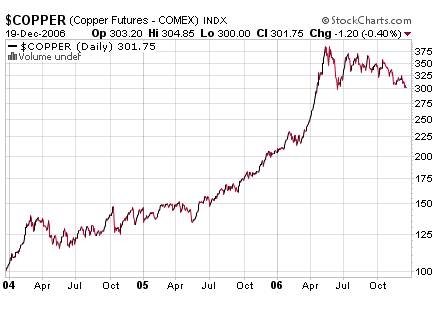
Copper, which is often seen as a harbinger for economic trends, looks particularly vulnerable. While the common perception is that China is the main driver for copper demand, in reality, the US economy is far more important. It may be true that China consumes 22% of global copper production compared to 13% for the US. But most of the Chinese demand can be attributed to manufacturers who use the copper they buy to produce goods that are eventually exported to the US.
Another source of copper demand is China’s growing infrastructure investments which are meant to expand manufacturing capacity. Therefore, a slowdown in the US will hurt China’s export sector and will cause a reduction in Chinese copper demand. I believe a US recession is imminent.
Already China is starting to move away from its investment-driven growth, shifting toward a more goods-related economy — a situation expected to tame its previously voracious appetite for copper. Chinese copper consumption declined by 4.7% in the first 10 months of the year according to the World Bureau of Metal Statistics.
In addition, copper demand from direct US consumption could suffer if the housing market, which consumes a quarter of the US copper demand, deteriorates. The average 2,100 sq.ft. single-family home uses 439 pounds of copper, most of which is for wiring and plumbing. If US housing starts were to fall by one million homes (about 50%) the reduction in US demand would be just under 200,000 tonnes of copper. This translates to an 8% reduction in US demand and a 1.25% reduction in global demand.
At the same time, the extended period of high copper prices has reduced demand, as alternatives have been found in aluminum and plastics. Independent industry consultant Simon Hunt estimates that around 3.5 million tons of copper in all forms could be replaced by alternative materials by 2010.
Global copper inventories monitored by exchanges in Shanghai, London and New York are the largest since 2004 after almost tripling in the past 18 months. Next year copper supplies will continue to rise, as several large-producing mines — Escondida, Codelco’s Chuquicamata, Grupo Mexico’s La Caridad and Cananea — return to full production, while expansions at Codelco’s Andina and Antofagasta’s Los Pelambres will also hit the market. Other mines such as BHP Billiton’s Spence, Phelps Dodge’s Cerro Verde, Equinox Minerals’ Lumwana and First Quantum’s Frontier will also come online for the first time.
Based on the median forecast of 11 analysts surveyed by Bloomberg copper is expected to fall to $2.61 a pound on average and will reach $2.10 in 2008. However any sort of collapse in the price of copper should be supported by a falling US dollar which I expect to pick up pace in 2007. This would cause copper’s US dollar price to appear stronger than it really is. My own forecast is that copper could trade between $2.50 and $2 per pound by the end of next year. I wouldn’t be surprised if it declines below $2 at some point in the future. However, if it reaches $1.50 I may go long.
