Category Archives: Stock Market

Repositioning My Portfolio After the Sell Off

Thursday saw major declines in US stocks, which at one point had the S&P 500 down 10% from its 52-week high — a threshold defined as a market correction. This was the first correction in 52 months and the end of the second longest streak since World War II. However, Thursday afternoon the markets recovered and further recouped losses on Friday after the Fed announcement that the discount rate had been cut by 50 basis points.

The reduction in the Fed’s discount rate is simply a confidence restoration measure since it is still half a percent greater than the fed funds rate and discount window lending is only available to depository institutions, who are not the ones suffering from illiquidity. Nonetheless, the Fed is clearly shifting to an easing bias and will likely reduce the fed funds rate if there isn’t much improvement in the credit markets. So now that we got the long overdue 10% correction out of the way and with the Fed setting the stage for a cut to the funds rate, it would seem the markets have put its worst days behind it. However, I am not convinced.

First, significant downside risk remains to asset prices because although central banks have been providing funds at lower than market rates, there is no guarantee that this will immediately reduce recent investor risk averseness. It has barely been a month since the start of the sell off and it is reasonable to assume that most funds will hesitate to increase leverage until the almost daily flow of headlines of fund blowups wanes.

Second, the unwinding of the yen carry trade may not have ended yet. Last May and June the unwinding forced the yen to appreciate to as high as 110 yen per dollar or about 4% more from where the rate trades currently. The yen is probably around 30% undervalued compared to the US dollar based on long term monetary inflation rates and purchasing power parity. The yen can easily rise to 100 per dollar over the next few quarters as the rest of the world lowers interest rates to stimulate growth and brings them closer to Japan’s. Such a rapid appreciation will diminish the attractiveness of the carry trade and put downward pressure on asset prices.

Third, the US consumer is tapped out and will reduce spending in the coming quarters. The trade deficit has been the biggest source of global liquidity because the dollars earned by foreigners are mostly invested in US assets which stimulates credit expansion in both the US and the exporter’s country. Assuming energy prices don’t rise, the trade deficit should improve. Moreover, an environment of declining consumer spending will hurt corporate profits and make equity valuations look expensive.

An early August Merrill Lynch survey of global fund managers showed that just 7% believed that a global recession is likely in the next 12 months, with most regarding the current turmoil as a buying opportunity. Not surprisingly, Street economists expect tightening credit to hurt consumer spending — but they’re still penciling in economic growth near 2%. Until economists and analysts cut their forecasts for economic and corporate profit growth to around zero, I can’t get bullish on stocks.

The US economy is highly leveraged and an extended period of deflation would be catastrophic. To prevent this, the Fed will surely inflate the money supply to the extent that is needed to counteract credit contraction. That will lead to a weaker US dollar, soaring consumer prices, disappointing equity and fixed income returns (in real terms), and a much higher gold price.

That said, although base metals prices declined along with other assets, they are still grossly overvalued, and I find it hard to be an aggressive buyer of gold as long as this remains the case. Many funds which speculated by buying gold along with copper, nickel, zinc, etc. may decide to sell gold along with the other metals to raise cash if any of the risks I outlined are realized. I did add to some of my gold positions during Thursday’s steep sell off, but I wouldn’t describe my buying as substantial.

I covered most of my short positions in base metals stocks and U.S. Steel (NYSE:X) on Wednesday and Thursday. I was up 25-35% on most of the shorts and they served their purpose of hedging my junior gold stocks which were hit hard. If base metal stocks rally from here, I will go short again. My remaining short positions are mostly in retailers. I am also keeping 30% of my portfolio in cash in case my favorite stocks get cheaper.
The LBO/Private Equity Party is Coming to an End

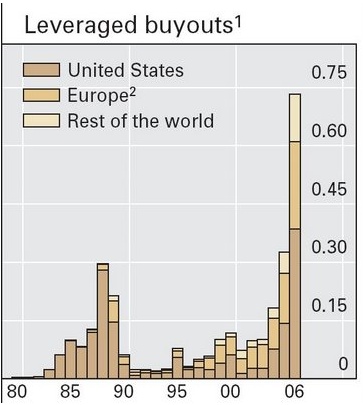
As the following graph shows, LBOs have surged in recent years:

LBOs

(Announced value of all deals, including net debt; in constant 2005 US dollars; based on the date of the announcement and the residency of the target firm.)
Source: Bank of International Settlements 2007 Annual Report

Blogger Sudden Debt points out:

In 2007 thus far, global LBO’s are running at a rate 33% higher than 2006. So, it looks as if we may easily surpass $1 trillion in LBO activity this year – assuming the current rate is maintained. Total global market capitalization was $55 trillion as of May 2007; withdrawing almost 2% of market value in one year does wonders for stock prices.

However, there is an absurdity lurking here: private equity and LBO firms are taking dozens of listed companies private, but they are going public themselves. The whole process does not make any sense at all: we are being asked to pay a premium over and above what the LBO firms paid themselves in order to end up owning the same assets. It is little wonder that their IPO’s are not faring well, so far.

Add the recent widening of credit spreads which is raising borrowing costs (e.g. the CDX High Yield index has jumped from 275 bp to 455 bp in the past 45 days) and we may already have seen the peak of the LBO activity, which translated into high takeover premiums being placed on stock markets.

The underwriters of the $20 billion of Chrysler debt — JPMorgan, Citi, Goldman Sachs, Bear Stearns and Morgan Stanley — could not sell the $12 billion portion of the deal tied directly to the Chrysler auto business. The banks have agreed to take on $10 billion of the $12 billion portion of the loans, while Cerberus and DaimlerChrysler will lend Chrysler $2 billion to complete the financing.

In Europe, Deutsche Bank is the lead arranger of the loan deal to finance KKR’s buyout of U.K.-based drugstore chain Alliance Boots. According to a Bloomberg report, it and other banks involved were unable to sell $10 billion of loans out of a total $12 billion to finance the buyout.

The black eye comes as the banks and their Wall Street rivals have belatedly sought to rein in their exposure to risky debt. According to sources in the markets, banks have cut back funding to collateralized debt obligations that buy mortgage debt, and increased their collateral requirements for lending to hedge funds.

Issuance of CLOs soared to a record $57 billion in the first half of 2007. That has since slowed to a trickle. So far this month, just $1.9 billion of CLOs have been sold, according to Standard & Poor’s Leveraged Commentary & Data.

This comes at a critical time, because banks are in the process of selling more than $200 billion of loans to investors. CLOs have been big buyers of those loans, now many of them aren’t getting sold.

Last month, the near-collapse of two hedge funds managed by Bear Stearns rattled the corporate debt market. The funds made big bets on subprime mortgage-backed securities, but also held some CLOs, which were offered for sale as the hedge funds’ assets were being liquidated. It isn’t clear if the CLOs were actually sold, but the prospect of a fire sale spooked some investors and made them reassess their appetite for riskier corporate debt.

LBOs were profitable in recent years due to low borrowing costs and strong corporate profits. With interest rates on risky debt rising, borrowing has suddenly become much more expensive for private equity firms. But the nasty surprise will come when consumer spending continues to deteriorate leading to a decline in corporate profits. That is when the LBO bubble will turn into a bust.

What’s Behind the Credit Worries?

The Economist explains what’s behind the fear of a liquidity contraction that shook the markets today:

Calling it a credit crunch might be an overstatement. But it does look like a credit squeeze. In recent years, investors’ enthusiasm for high-yield products has allowed borrowers free rein in the debt markets. Blessed by strong profits and buoyant economic conditions, companies seemed more than capable of paying back their debts; default rates have been remarkably low.

Indeed, such was the power of borrowers, private-equity groups chief among them, that they were able to dispense with the market’s traditional safeguards. They dropped some of the covenants that gave lenders the right to act if the borrower’s finances deteriorated.

Suddenly, however, investors are turning their noses up at some deals. Banks that had lent large sums to finance the buy-out of Chrysler, the car giant, and AllianceBoots, the drugs retailer, had hoped to sell these loans to an eager market. This week both debt sales were postponed in the face of sniffy investors. A similar sale to fund the buy-out of US Foodservice, a food distributor, was scrapped last month. Even before the latest news Baring Asset Management counted 28 corporate-bond or loan deals, worth around $17 billion, that had been pulled since June 22nd.

What has prompted this change of heart? Many point to the problems in the American subprime-mortgage market, where defaults have risen and several hedge funds have been wiped out in the process. Countrywide, a mortgage bank, has triggered further concerns by admitting that bad-debt problems are now spreading to conventional loans.

When investors suffer losses in one part of their portfolio they get nervous about potential problems elsewhere. On July 20th the European crossover index, which covers riskier corporate debt, suffered the worst day in its short history. The spread (excess interest rate) over government bonds widened by two-fifths of a percentage point.

Investors may also be suffering from indigestion. According to Moody’s, a rating agency, nearly $1 trillion was raised in European credit markets in the first half of the year. Greg Peters, a Morgan Stanley strategist, says that $57 billion of bonds and more than $200 billion of loans are already in the pipeline: a plentiful supply of debt to absorb the potential demand.

It is hardly surprising, therefore, that investors have decided that higher yields are needed. This has caused a temporary hiatus as issuers get used to the new regime. But it looks more like a return to normality than a buyers’ strike. Credit-default swaps (which insure investors against a failure to repay) reflect this shift in sentiment. Jim Reid, the credit strategist at Deutsche Bank, says swap spreads in the European high-yield market are now wide enough to compensate for the average historic default rate. In America spreads are well above that level.

Pushing spreads further might require some actual defaults. That, in turn, would probably require the global economy to weaken significantly. At the moment, however, economists seem pretty sanguine, forecasting output growth of 2.7% for America in 2008 and 2.3% for both the euro area and Japan.

A benign view of the economic outlook may be why the Dow Jones industrial Average recently passed the 14,000 level for the first time. But stockmarkets have shown signs of concern at developments in the credit markets; their latest wobble was on July 24th.

Some of the fundamental supports for equities are being eroded. In America, corporate profits are on course to grow by 5.5% in the year to the second quarter, a long way below the double-digit rises to which investors have grown accustomed. The proportion of firms beating expectations in the second quarter was at its lowest since late 2002. By the measure derived from America’s national accounts, profits fell in the fourth quarter of 2006.

And the takeover boom may be near its peak. “The tide appears to be going out for leveraged equity financiers,” says Bill Gross of the bond giant Pimco. Bids have become more expensive to finance while share prices have been rising. Citigroup says that, in mid-2005, the corporate-bond yield was 4.4% and the trailing earnings yield on European equities was 6.8%. That made it highly attractive to issue debt to buy shares. But by mid-July the bond yield was 6.1% and the earnings yield 6.3%, a much less attractive trade.

Predators can be inventive in finding sources of finance for their deals, as Barclays has shown. At the margin, however, bids are becoming harder to pull off. The banks are now stuck with the risk of the AllianceBoots and Chrysler deals. They won’t want to make that mistake again.

I am betting that this is just the beginning of a substantial rise in risk premiums.

The Shenzen Composite and Nasdaq

I just noticed an Economist article published a couple of weeks back that underscores the current craze in Chinese equities.

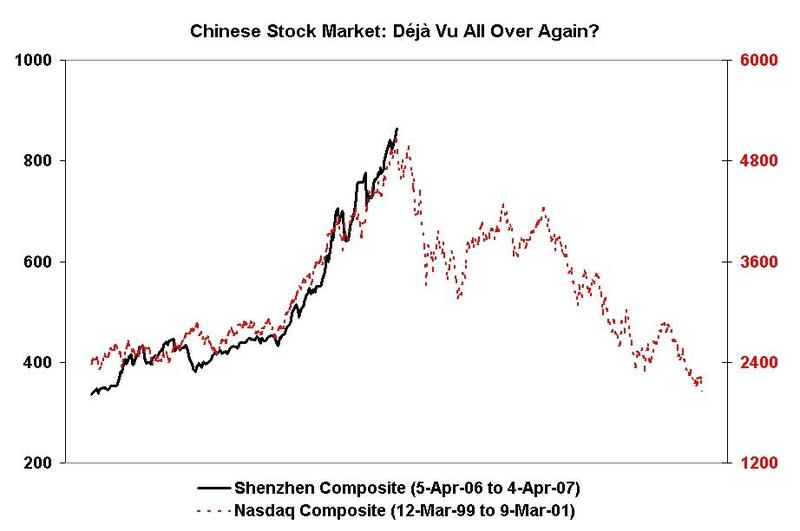
As the following chart by Michael Panzer illustrates, the Shenzhen Composite is starting to look eerily similar to the bubble stages of the Nasdaq Composite during 1999 and 2000.

chinanasdaq

Will the Shenzhen Composite suffer the same fate as the Nasdaq’s during 2000 and 2001? I think it’s a certainty though I’m not sure when.

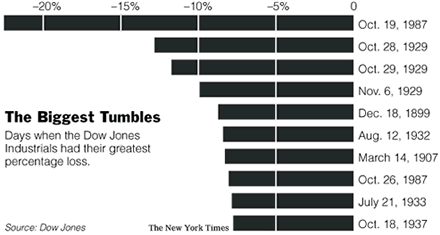
The Worst Days for the Dow

The New York Times points out that as painful as Tuesday’s 3.3% plunge in the DJIA was, “you could almost call that a blip when measured against the biggest plunges on record.”

dow_greatest_daily_percentage_loss

My gut tells me that we will get at least one more day this year that will surpass Tuesday’s drop.

Some Thoughts on Yesterday’s Stock Market Panic

Yesterday a 9% tumble in China’s stock market spread across the world causing the Dow to fall by 3.3% and many emerging markets to decline by even more. It is difficult to determine exactly what triggered the Chinese market sell off, but there were rumors circulating that the government will be introducing a capital gains tax.

Now its important to keep in mind that Chinese stocks have tripled since 2005. When stocks appreciate by so much in such a short time investors are looking hard to find an excuse to book profits. The rumor of a capital gains tax may have provided them with just that.

Whenever a large market such as China experiences some sort of chaos, it is reasonable to expect nervousness to spread around the world. China is an important US trading partner and US stocks fell in sympathy. Many emerging markets dropped because they are dependent on supplying China with commodities and raw materials.

The yen carry trade also played a role in causing the selling to spread beyond China. Yesterday, the yen appreciated by 2.3% amid the panic. This indicates that financial institutions that had borrowed yen to buy Chinese stocks, cut their losses by selling their stocks and buying back yen to close the trade. As the yen appreciated, others who were engaged in the carry trade were also forced to raise liquidity by selling their global stock holdings.

Yesterday, I watched CNBC for the first time in a while just to see if most of the talking heads had changed their rosy outlooks on stocks. Unfortunately, the consensus seems to be that the plunge was simply a correction and not the beginning of a bear market. As a contrarian, I feel comfortable believing that yesterday’s pain is just the tip of the iceberg.

ProShares ETFs

Last July ProFunds released an interesting ETF product, called ProShares, which can provide double the inverse performance of some of the major indices. These are in addition to several other ProShares leveraged offerings:

Fund Ticker Benchmark Index
Leverage
Short QQQ PSQ NASDAQ-100
minus 1x
Short S&P500 SH S&P 500
minus 1x
Short Dow30 DOG DJIA
minus 1x
Short MidCap400 MYY S&P MidCap 400
minus 1x
Ultra QQQ QLD NASDAQ-100
2x
Ultra S&P500 SSO S&P 500
2x
Ultra Dow30 DDM DJIA
2x
Ultra MidCap400 MVV S&P MidCap 400
2x
UltraShort QQQ QID NASDAQ-100
minus 2x
UltraShort S&P500 SDS S&P 500
minus 2x
UltraShort Dow30 DXD DJIA
minus 2x
UltraShort MidCap400 MZZ S&P MidCap 400
minus 2x

There already exists a few open ended mutual funds from ProFunds and Rydex that do the same thing, but they come with expense ratios of around 1.5% compared to only 0.95% for the ProShares.

As a bear I was attracted to the double inverse ProShares since they can be held within retirement accounts. I would also be interested in holding them in my non-retirement accounts if they offered more leverage than shorting. Due to the margin requirements of my broker I am required to have 130% of the value of a short position of any option eligible securities. Buying ProShares, on the other hand, requires margin of 50%.

To use the UltraShort S&P 500 (AMEX:SDS) as an example, every $100 of margin in my account allows me to hold $200 of the SDS (or $200 of double the inverse of the S&P 500). If I were to short $200 of the S&P 500 in the traditional sense through the Standard & Poor’s Depository Recipts (AMEX:SPY), I would need only $60.

Now let’s say the S&P 500 declined by 10% after 1 year. Then my $200 holdings of SDS will gain by 20% or $40. Since I invested only $100 my return would be 40%. On the other hand, my $100 would allow me to short a maximum of $333.33 of SPY. Since the S&P 500 fell be 10% the SPY will fall by 10% too. Under this scenario I would gain $33.33 or 33.33%.

Of course leverage can work both ways: if instead the S&P 500 had increased by 10% I would have lost 40% through buying the SDS compared to only a 33.33% loss by shorting the SPY.

There are some other costs associated with holding the UltraShort ETF’s that were not factored in this analysis. First, buying with margin entails interest expenses on the loan amount. In my case, currently my broker charges 6% annually. Second, there is an expense ratio of 0.95% for all ProShares. And third, the funds employ swaps which can have negative tax consequences.

As good as these ETFs are, they are not superior to shorting or even futures which can offer much more leverage. These products are better suited for accounts that are unable to short like retirement accounts.

I currently own the SDS and the UltraShort MidCap 400 (AMEX:MZZ) in my retirement accounts.

Will Cramer Be Right?

I found some excerpts of an interview that BusinessWeek conducted with CNBC’s star personality Jim Cramer. When asked about his outlook for 2007, he doesn’t hide his bullishness:

I think it’s going to be real good… We have incredibly low interest rates. Forget the big mortgage problem. The big story for 2007 is that we just don’t have enough stock. Twenty-nine of the 30 stocks in the Dow Jones average have buybacks. If you take a look at the moves you see in stocks now, it’s because there are just no sellers… Then layer on the fact that the private equity guys have just raised $3 trillion… Those forces are all fabulous for the market.

Now I’m no fan of Cramer’s but I thought I would simply make a note of it so that 12 months from now we can look back and see if he’s right.

Cramer’s a sharp, charismatic and hard working individual but that doesn’t necessarily make someone a great investor. He always prefers to go long on stocks. When stock prices decline, he simply increases his position betting that the market is merely experiencing a correction. This strategy works well during bull markets. Not surprisingly he came to prominence as a successful hedge fund manager during the eighties and nineties — a period when stocks were on a spectacular bull run. During a bear market his strategy could cause him to underperform the market.

I think difficult times are ahead for the stock market — and Jim Cramer’s popularity.

The Coming Bear: Stock Market Crash (Part 4)

In the last post of this series, The Coming Bear, I discussed the reasons why I believed the economy was headed for a housing-led recession in 2007. If this turns out to be correct the stock market is going to fall dramatically and will probably challenge the 2002 lows.

Even if I am wrong and the economy continues to grow at its current pace with corporate earnings rising along with it, the stock market is overvalued by almost every measure:

  • P/E ratios are well above the historical average of about 15. Typically the beginning of a bull market is signaled when P/E ratios fall below 10. Currently, the S&P has a P/E ratio over 18.
  • The Dow/Gold ratio currently trades at 19. This ratio has equaled 1 a few times in the past which made for a great time to buy the Dow and sell gold. Right now gold is the better buy.
  • The Dow dividend yield stands at 2.17% which is less than half of the yield on the 10-year treasury. Many times in the past Dow stocks were yielding over 5%

For these reasons it is very hard to imagine that stocks will produce above average returns in the future. Now if I am correct and the economy does suffer a housing-led recession and earnings do fall, then we could see stock prices get hit very hard.

Almost all sectors of the stock market should be negatively affected including retailers, technology, transports, financials, commodities, and of course real estate. Only gold stocks will be spared since their performance depends not on economic growth, but on monetary and foreign exchange conditions.

If you really want to protect yourself from the coming bear market, the best strategy is to sell all of your stocks. Now this may sound heretical to you since you have always heard that stocks are the best performing asset class over the long term. But this depends on what is defined to be long term.

Consider that from 1968 to 1979 the best performing asset was gold which increased 19.4% annually. Stocks on the other hand gained only 3.1%. If you owned stocks during this period you actually lost money since inflation was running at 6.5%.

I am not sure how you feel, but I feel 10 years is a long time and I would hate to lose my money over so many years. So it is possible stocks can perform very badly for a long time. As discussed in this series of posts I believe we are in such a period. The bear market began in 2000 and should last for around 10 years. If you want to preserve your investments for the rest of this decade do the most logical thing… sell your stocks!